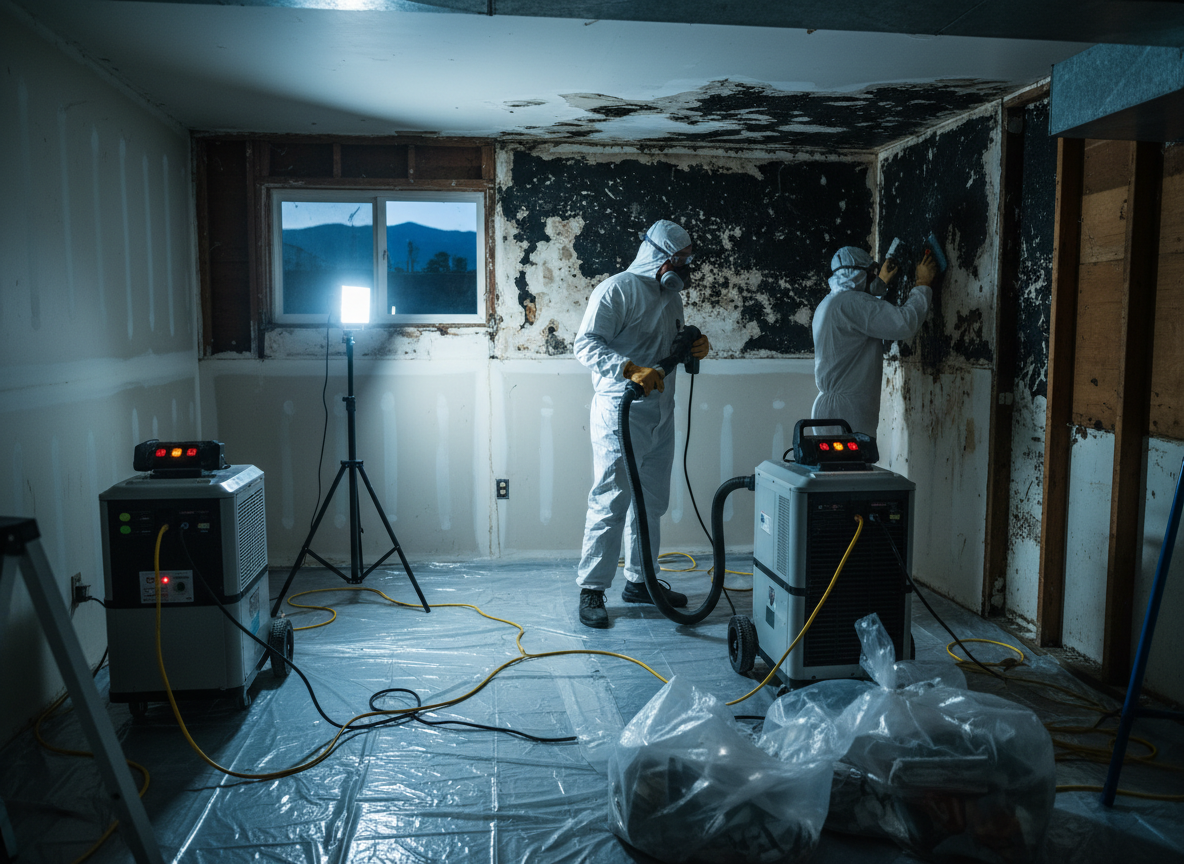
Verdugo City homes built in the 1950s and 1960s often feature lath-and-plaster walls over wood framing that trap moisture from small plumbing leaks or roof penetrations. In the area's Mediterranean climate, warm dry summers mask slow seepage that only becomes visible during mild winter rains, allowing colonies to establish behind surfaces before residents notice odors. Technicians must cut precise inspection openings and use moisture meters calibrated for plaster to avoid missing growth that travels along joists toward shared walls in these dense neighborhoods.
Containment protocols differ here because many properties sit on sloped lots near the Verdugo Mountains where gravity pulls water toward foundations. Negative air machines with HEPA filtration pull spores away from living spaces while crews remove saturated drywall and insulation. Edge cases include mold migrating into HVAC ducts common in Glendale-adjacent ranch homes, requiring line cleaning rather than simple surface treatment to prevent re-circulation once the system restarts.
Los Angeles County building codes require proper disposal of contaminated materials at approved facilities, and crews document every step for insurance adjusters who frequently review claims from this zip code. Homeowners sometimes attempt bleach cleaning on visible spots, which fails on porous substrates and drives spores deeper into framing. Professional removal addresses both visible colonies and the moisture source, such as unsealed stucco cracks that allow fog drip to enter during overnight marine layer events.
Technician insight
In Verdugo City, the thing that catches most people out with 24 hour mold removal is how 1950s plaster walls over open crawlspaces let condensation from mild winter nights travel along floor joists into adjacent rooms without obvious ceiling stains.
Slow Leak Behind Plaster in Verdugo City Home
A resident near Honolulu Avenue reported a persistent musty smell after winter rains. Inspection revealed mold colonies growing on lath behind a bathroom wall fed by a hairline pipe leak. Crews contained the room, removed the plaster and insulation, treated the framing, and confirmed clearance with air sampling before reinstalling finishes.
How it works
- 1
Emergency Assessment
Technicians arrive within hours, use infrared cameras and moisture meters to map hidden growth, and identify the water source in Verdugo City construction.
- 2
Containment Setup
Plastic barriers and negative air pressure isolate the work zone so spores do not migrate into unaffected rooms common in these older floor plans.
- 3
Removal and Treatment
Affected materials are removed, surfaces are cleaned with EPA-registered antimicrobials, and the underlying moisture issue is corrected before drying begins.
- 4
Clearance Testing
Air and surface samples confirm remediation success before barriers come down and normal occupancy resumes.
Pricing
Pricing varies with the square footage affected, depth of hidden growth, and any HVAC involvement.